Are you building a team of AI agents using the org chart from a startup in the 2020s?
Look at LinkedIn. Everyone is telling you to build teams of agents based on a standard corporate playbook. The Researcher. The Marketer. The Assistant.
We are obsessed with recreating the 20th century org chart in silicon. We name agents after job titles because that is how we manage humans. But AI is not human. Treating it like one is an expensive mistake.
The Functional Fallacy
We are applying a human organizational model to a non human problem. We break human teams into functions because we have biological constraints. A world class marketer rarely writes production grade code. Specialization is a necessity for our limited bandwidth.
But AI models do not have these bottlenecks. A single LLM can draft a high converting ad campaign one minute and refactor a complex codebase the next. When you specialize agents by function you are not optimizing for capability. You are introducing artificial latency. You are increasing API costs. You are creating hand off hallucinations.
Stop organizing by department. Start organizing by constraints.
Building on Structural Foundations
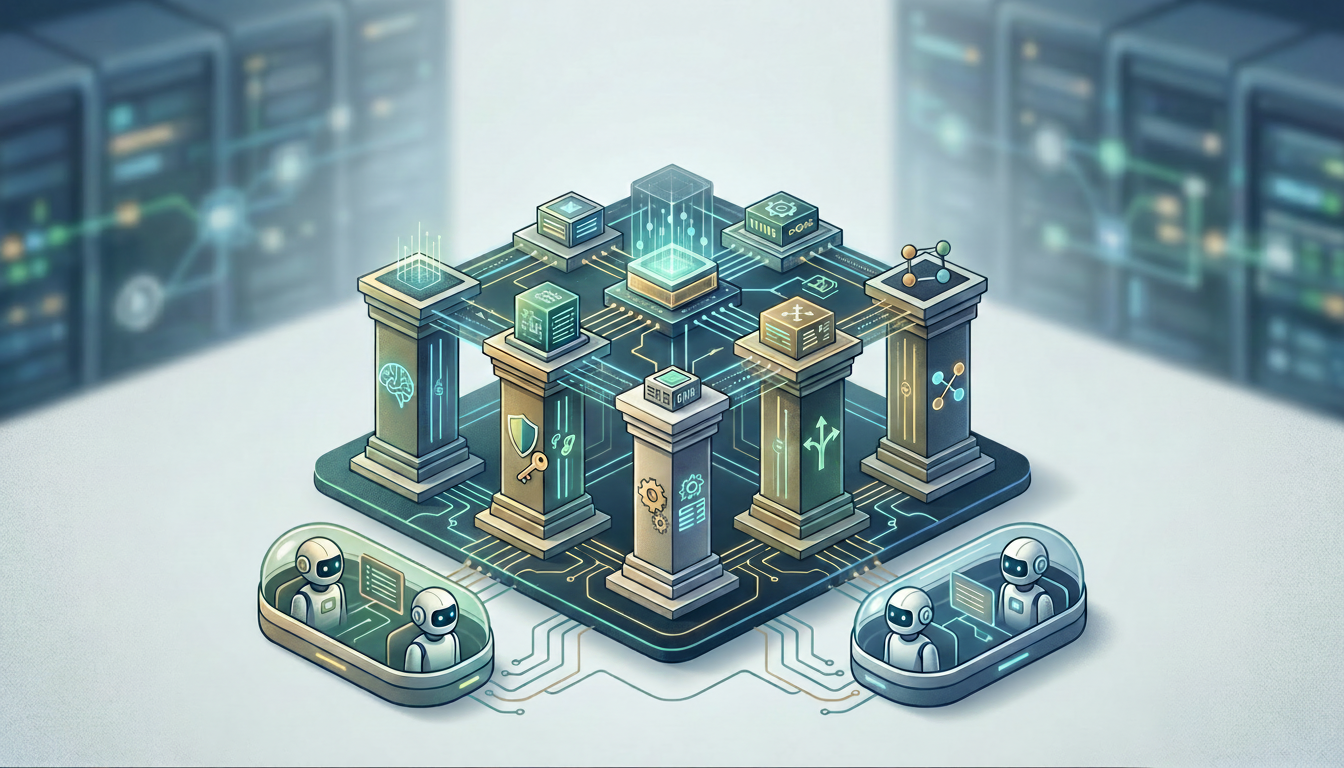
I believe teams of AI agents should be built on structural foundations. It is not about what they do. It is about how they are constrained. Here is the framework I use to architect agent deployments.
1. Intelligence Tier: Reasoning vs ROI
Do not use a Ferrari to go to the corner store. Match your model reasoning depth to the specific task requirements. Deploy massive frontier models for high stakes strategic analysis. Use nimble efficient models for routine data formatting. If you over engineer every step your unit economics will destroy your ROI.
2. Permission Scoping: The Security Sandbox
This is your most rigid wall. The division of labor should be defined by what the agent is allowed to touch.
Think about your file system. A dev agent might have Read Write access to a specific /temp folder but only Read Only access to your /production directory. Or look at your online systems. Does an agent need to read every single email in your inbox? Or should it be scoped to only see messages with a specific tag? Can it draft a tweet for your review? Or does it have the permission to post on social for you?
Finally think about human interaction. There is a massive difference between an agent that only talks to your defined list of customers and one that can talk to anyone on the open internet. These are different risk and cost profiles. Compliance is the bedrock of agentic design.
3. Computational Resources: The Hardware Floor
Compute is a finite asset. Some agents need a heavy lifting environment while others can run on a thin slice of resources.
Think about a Code Execution Agent. If it is running complex simulations or processing massive CSV files in memory it needs a high CPU and high RAM container. It is doing heavy math. It needs the horsepower.
Compare that to a Routing Agent. Its only job is to look at a prompt and decide which path to take. That needs almost no memory and minimal CPU. It is a light switch. Do not waste expensive high performance compute on a light switch. Build your team based on the physical weight of the work.
4. Spontaneous Parallelism: The Expansion Joint
Humans cannot clone themselves when a task gets hard. AI can. You should build your architecture to launch short lived sub agents for three specific reasons.
First is for reasoning heavy subtasks. If you are debugging a deep logic error you spin up four agents to chase four different theories at once. Second is to protect your context. If a task generates 50 pages of intermediate data you do not want that clogging your main agent memory. You offload it to a temporary worker and just take the summary back. Third is for independent workstreams. Why wait for a market report to finish before starting the budget draft? Run them in parallel. Kill the sub agents when the work is done.
5. The Adversarial Loop: Executor vs Auditor
Never let an agent validate its own work. That is how you get feedback loops that drift into chaos. You need an Auditor. This is a separate specialized node. Or even a simple rule based system. It acts as the check on the Executor. The Executor builds. The Auditor verifies. Keep them decoupled to ensure quality.
Final Thoughts
This might sound complex. But for most small to medium business owners the answer is actually simple. You probably only need two agents.
One agent for internal work. It has access to your sensitive docs and works on strategy. One agent for external work. It is scoped to talk to customers and prospects.
Given the state of technology today this two agent model makes the most sense. It keeps your data safe. it keeps your costs low. And it actually works.
What is Next?
Are you a small business owner interested in implementing agents? Schedule a chat. We would love to have a quick chat about how to get you started.
What is the risk and cost profile for internal vs external agents? That is a big topic. We are sharing a new blog post to talk specifically about those trade offs next week. Stay tuned.